

James Boon, Free Black Carpenter of Franklin County
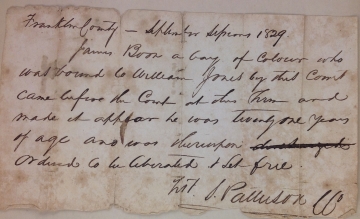
In 1829 Franklin County Clerk of Court Smith Patterson confirmed that James Boon had been released from his apprenticeship to William Jones. James Boon Papers, State Archives of North Carolina.
Historian John Hope Franklin published a substantial scholarly article in 1945 on the life and work of James Boon, a free black carpenter who was born in or near Louisburg in 1808 and spent most of his life there. Dr. Franklin’s essay, which makes effective use of Boon’s papers in the North Carolina State Archives as well as Franklin County court minutes and deeds, provides a rare picture of a skilled artisan who lived at a time when free people of color struggled on the margins of society.
Boon is fortunate that in 1827, William Jones (b. ca. 1785), a white carpenter in Louisburg, accepted him as an apprentice. According to architectural historian Catherine Bishir, this was not an unusual practice in antebellum North Carolina, and it provided the opportunity for Boon to learn a trade that later supported him, his wife, and a son. Jones was a skilled craftsman who had a good reputation in the community. Planter Nicholas Massenburg hired Jones in 1838 to build his plantation house, Woodleaf, located a few miles northeast of Louisburg. According to Bishir, Jones’s crew typically consisted of white, free black, and slave carpenters.
Although Jones trained Boon well in his chosen trade, he did not teach him how to read and write, which was a legal requirement of the day. This failure is reflected in documents in Boon’s papers, some of which he signed with an “X” instead of his name. Boon completed his apprenticeship in 1829. Thereafter, Jones appears to have charged Boon a modest annual fee for keeping his financial accounts and sometimes wrote letters for him.
Boon’s papers document work he did in Louisburg as well as his business dealings with local merchants. In 1835 he was paid $21.12 for making repairs to the Franklin County Courthouse. Private clients included Benjamin Avery, Augustus Lewis, and Elizabeth R. Yarbrough. In addition to carpentry work, Boon sometimes made store fixtures. He purchased lumber from A. S. Perry and from the firm of Patterson and Dent. His household dry goods came from such firms as Ballard, Harris, and Davis.
Some jobs required Boon to hire help. Free blacks who worked for him included William Dunston and William Mitchell. On occasion he hired slaves belonging to whites. These included Adam and Granville, the slaves of William F. Collins.
Because Louisburg in the 1830s and 1840s was little more than a village, Boon sometimes sought work elsewhere. He is known to have worked for clients in Halifax and Wake counties. In 1848 Boon’s brother, who lived in Wilmington, encouraged him to move there, but the hostility to free blacks in the port city caused him to return to Louisburg. Any such travel was difficult because of the possibility of being mistaken for a slave. Thus Boon always carried recommendations from his clients. These documents reveal that he was a highly skilled, reliable craftsman.
Boon’s skill and industry enabled him to accumulate a small amount of property, but his habits caused him some difficulty. He owned a lot, house, and shop in Louisburg and a small amount of land outside the town. Prior to 1843, he acquired a slave boy named Lewis, who eventually helped Boon with his work. Receipts in Boon’s papers reveal his tendency to purchase fine clothes that likely were beyond his means. He was often in debt and occasionally mortgaged his property, including his slave, to satisfy his creditors.
Boon also enjoyed brandy and other spirits. One of the contractors for whom he worked, Dabney Cosby, wrote him a recommendation in 1850 that hints at the impact drinking may have had on the carpenter’s work: “The bearer Jim Boon has been in my Employ for some time and but for liquor would have done very well. he is a good workman.”
Beginning in the late 1840s, Boon spent much of his time working in Raleigh, leaving his wife Sarah, a semi-literate slave who belonged to Maria Stallings. In 1850 Sarah wrote Boon, accusing him of infidelity, but also expressing forgiveness. She begged him to return to Louisburg. She believed that their relationship was more important than “all the money you could make.”
Boon made a different choice. In 1851 he rented a house in Raleigh and, in 1854, married Mahaly Buffaloe. The following year, he sold his property on Court House Street in Louisburg to Edward L. Stegall. Boon’s will, which was not discovered by Dr. Franklin, sheds valuable light on the carpenter’s final years. Written in May 1858, the document states that Boon was living in Chatham County but that he was a resident of Raleigh. By this time, he and his wife had two daughters, Mary Ann and Charlotte Ann. He still owned the slave named Lewis, whom he placed in the care of his friend and executor, Alfred Williams, with the stipulation that Lewis should have “all the proceeds of his labor.” Boon died soon after his will was drafted, as it was offered for probate during the November 1858 term of the Wake County Court of Pleas and Quarter Sessions.
Many years later, the Williams family donated Boon’s papers to the North Carolina Historical Commission, a clear indication of the respect they had for him and an act that enabled a nationally known historian to reconstruct his remarkable life.
Published in The Franklin Times on January 28, 2016.
Maury York is director of the Tar River Center for History and Culture at Louisburg College. He wishes to credit information in the following articles: John Hope Franklin, “James Boon, Free Negro Artisan,” Journal of Negro History 30 (April 1945): 150-180; Catherine W. Bishir, “Black Builders in Antebellum North Carolina,” North Carolina Historical Review 61 (October 1984): 423-461. Both were accessed through JSTOR.