

Remembering Cedar Rock Academy in Rural Franklin County
By Maury York

The morning of May 29, 1894, dawned brightly in eastern Franklin County. At 10 o'clock, six leading pupils of the Cedar Rock Academy and Business Institute - G.W. Newell Jr., G.W. May, Willis H. Smith, James Coppedge, R.H. Cheek, and T.O. Coppedge - assembled before a large crowd to present their declamations.
One by one, the students stood to give their speeches. After careful deliberation, the judges, who considered each effort meritorious, awarded the gold declamation medal to Smith.
It was an exciting start to the second day of the school's first annual commencement ceremonies. After a "literary address" given by Professor J.B. Carlyle of Wake Forest College, the large crowd enjoyed a profuse array of refreshments, then settled in for the afternoon ceremonies.
Pearl Pearce won the recitation contest and received a gold medal for her effort.
The Rev. W.A. Smith, principal of the school and a recent graduate of Wake Forest College, awarded the scholarship gold medal to Mary Cheek, who had amassed a nearly perfect academic record.
The music students of Loula Long entertained the audience. Among the highlights was R.H. Cheek's performance of "How Ruby Played."
Why had a private school been organized in the country, miles from Louisburg or Nashville?
Although North Carolina had begun a system of "common" schools before the Civil War, public schools did not flourish during the late 19th century.
In 1880, most public schools were open only nine weeks a year, and perhaps one-third of the state's school-age children attended them. Illiteracy was rampant.
Twenty years later, more than half of the state's children were enrolled in public schools, but not all of them attended regularly, even though the school year was only 60 days long. It was not until after 1900 that North Carolina became serious about developing a robust public school system.
The founders of the school laid a solid foundation. They erected a two-story brick building containing six rooms that were "well adapted to their specific purposes."
The General Assembly of 1895 incorporated the school as Cedar Rock Academy, naming five local farmers - J.A. Coppedge, R.R. Boone, W.G. Collins, J.W. Sledge, and W.A. Parish as incorporators.
The school's trustees made arrangements for both day and boarding students, who could rent rooms in nearby homes for seven dollars a month.
Cedar Rock Academy offered a varied curriculum. According to the catalog for 1895, students in the primary department received instruction in reading, writing, and arithmetic, geography, and North Carolina history.
Those in the academic department studied increasingly advanced courses, including algebra, geometry, Greek, and Latin, that prepared them to attend college. Classes in art, music, bookkeeping, law, and telegraphy were also available.
When Franklin County completed the Edward L. Best High School in 1925, the principal of Cedar Rock Academy, T.H. Sledge, became its principal.
The academy's brick building stood for many more years near the Cedar Rock Baptist Church, but was eventually removed.
Published in The Franklin Times on September 26, 2013.
Maury York is director of the Tar River Center for History and Culture at Louisburg College.
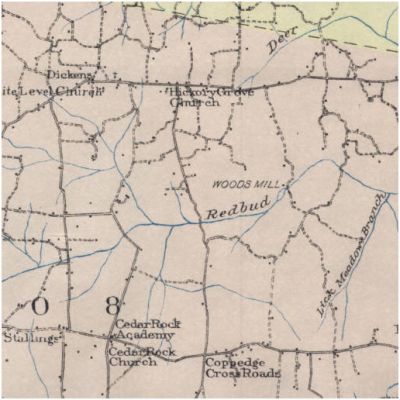
Photo credits: Section of map of Franklin County, ca. 1906-1907, courtesy of North Carolina Maps
(http://www2.lib.unc.edu/dc/ncmaps/index.html)
Declamation medal of Willis H. Smith, 1894, courtesy of Louisburg College