

Franklinton Was Home to Private Academies in 1850s
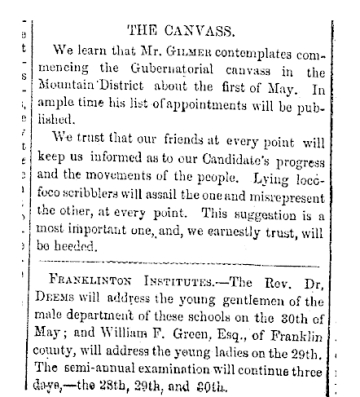
This advertisement in the April 23, 1856, edition of The Weekly Raleigh Register announced the forthcoming commencement address of Charles Force Deems, Methodist Episcopal Church clergyman and former president of Greensboro Female College.
Franklinton, which was incorporated in 1842, three years after the Raleigh and Gaston Railroad reached what was first called Franklin Depot, grew quickly in the 1840s and 1850s. The new town attracted residents, businesses, churches, and schools. Two private academies, Franklinton Male and Female Institutes, flourished for a brief period in the mid-1850s.
Franklinton and its railroad played an important role in the economy of Franklin County. Prior to the construction of the railroad, many area farmers had transported their cotton, tobacco, and wheat over poor roads to markets in Petersburg or Richmond—a time-consuming and expensive endeavor. The depot at Franklinton soon eased this burden for many.
Franklinton grew to around 200 residents by the late 1850s and attracted carpenters, masons, merchants, shoemakers, cabinetmakers, a coach maker, a blacksmith, and professionals, including a doctor and lawyer. Many children attended the county’s new public or “common” schools, but some families of means chose to send their sons and daughters to private academies.
Franklinton Male and Female Institutes, established prior to 1854, offered a broader education than was available in the common schools. Mr. and Mrs. D. S. Richardson, who had previously operated academies in the vicinity of Castalia, served as heads of the schools. In his Historical Sketches of Franklin County, the Rev. Edward Hill Davis quoted from an article about the schools that appeared in the January 4, 1854, issue of the Spirit of the Age: “The Male and Female Departments are distinct. The buildings are spacious, well arranged and pleasantly located half a mile apart, in different portions, and near the borders of the village, admirably combining the advantages of town and country. The students will board in well regulated boarding houses, in the immediate vicinity of their respective Departments, with the Trustees and Instructors, and under the supervision of both.”
Male students who enrolled in the preparatory course paid tuition of $10 per session. The regular English course, with classics, ranged from $15 per session for the first three years to $20 during the senior year. For female students, the regular English course cost $12.50 per session. For additional tuition, girls could take French, Latin, piano, guitar, drawing, painting, or ornamental needlework lessons.
Public speaking apparently was an important part of the schools’ offerings. Extracurricular activities of the young men included participation in the Washington Literary Society. An advertisement in the Raleigh Register of May 12, 1855, announced the forthcoming semi-annual examinations, with “Rhetorical Exercises” by the students and addresses by distinguished speakers.
On February 16, 1855, the North Carolina General Assembly incorporated the Franklinton Male and Female Institutes, naming Allen C. Perry, Dr. Edward A. Crudup, Dr. L. A. Jeffreys, C. C. Blacknall, W. H. Joyner, W. B. Dunn, J. M. Stone, Col. Isaac Winston, J. H. Whitfield, T. J. Whitfield, Henry T. Clawson, W. O. Green, A. D. Ellis, Joseph Kearney, Weldon E. Person, and James S. Yarborough as trustees.
By the end of that year, the schools were overseen by additional staff. Mr. and Mrs. E. P. Stone served as assistant principals. Mr. R. J. Taylor assisted in the male institute, and Miss M. L. Townsley, a graduate of Troy Female Seminary, provided instruction in the school for young women.
According to historians Davis and T. H. Pearce, however, the Franklinton Male and Female Institutes suspended operations in 1856, because of an outbreak of typhoid fever. Indeed, one of the school’s trustees, Dr. L. A. Jeffreys, who also served in the North Carolina House of Commons, died of the disease in December of that year. The Richardsons left Franklinton, and the Masons in Franklinton purchased the school properties. In 1857 they opened them as Masonic High School.
Published in The Franklin Times on August 25, 2016.
Maury York is director of the Tar River Center for History and Culture at Louisburg College. He wishes to acknowledge articles in Raleigh newspapers located through the 19th Century U.S. Newspapers database of Gale Cengage Learning.