

Noted Photographer Documented Architecture of Tar River Region
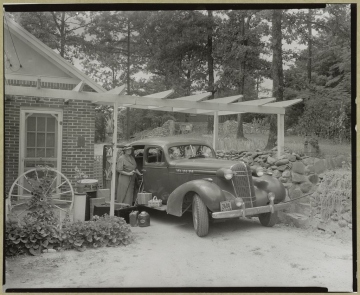
Frances B. Johnston at the Wheel Inn, Morganton, N.C., 1938, Frances Benjamin Johnston Collection, Library of Congress Prints and Photographs Division.
Frances Benjamin Johnston (1864-1952), a leading American photographer of the late nineteenth and early twentieth centuries, came through North Carolina during the Great Depression to document some of the state's outstanding architecture. She recorded exterior and interior details of a number of important buildings in Franklin, Granville, Halifax, Nash, Vance, and Warren counties and published many of her photographs in a noteworthy history of the state's architecture.
Johnston was born in West Virginia, but moved with her family to Washington, D.C., around 1875. She studied art at the Academie Julian in Paris between 1883 and 1885, then returned to Washington. Kodak founder George Eastman gave her a camera in 1888, and she quickly developed an interest in photography. She photographed important political figures, including several presidents, and worked as a photo journalist for the Bain News Service. Johnston published articles in important American magazines.
During the 1930s, the Carnegie Corporation of New York awarded Johnston six grants to document the historic architecture of the South through her photographs. A grant for $4,500 in 1936 enabled her to work in Maryland, North Carolina, and South Carolina. With the help of a chauffeur, she traveled the length and breadth of the Tar Heel State, taking hundreds of shots of buildings of all kinds. Dating from the eighteenth and nineteenth centuries, these structures included not only fine plantation houses and elegant townhomes, but also modest dwellings and distinctive farm outbuildings.
Not long after Johnston's visit to North Carolina, the North Carolina Society of the Colonial Dames of America instigated a book project to make these photographs widely available to readers. Mrs. Katherine Pendleton Arrington of Warrenton chaired the chapter's Committee on Publications and thus played an important role in the endeavor. Johnston collaborated with Thomas Tileston Waterman, an architect who had been recording many of the same properties for the Historic American Buildings Survey sponsored by the National Park Service. Waterman provided background text and measured drawings that placed Johnston's photographs in the context of North Carolina's socio-economic and architectural development.

A Peggy Wright Farm, Louisburg, Franklin County, North Carolina, 1938, Carnegie Survey of the Architecture of the South, Library of Congress Prints and Photographs Division.
The University of North Carolina Press published The Early Architecture of North Carolina: A Pictorial Survey in 1941. Gertrude Sprague Carraway's review in The North Carolina Historical Review praised the book and its outstanding photographs. "A meritorious feature is that the text and pictures are not confined to the most showy and glamorous types of buildings," she said, "but the whole story of North Carolina architecture is presented graphically and faithfully. And, to the high credit of Miss Johnston and Mr. Waterman, they make picturesque and appealing the simple log cabins, corn cribs, tobacco barns, cotton presses, wagon sheds, dog run and saddle-bag houses."
Johnston's agreement with the Carnegie Survey of the Architecture of the South required her to deposit her photographs in the Library of Congress. The images found their way there after her death. Many of them have been digitized and are freely available for study and enjoyment on the library's Web site: http://www.loc.gov/pictures/collection/csas/. The finding aid for the Carnegie Survey of the Architecture of the South allows one to search for Johnston's photos of particular North Carolina counties. Here one can find images of houses in the Upper Tar River region, some of which no longer stand, that help us understand the history of this often overlooked section of the state.
Published in The Franklin Times on June 25, 2015.
Maury York is director of the Tar River Center for History and Culture at Louisburg College. He gratefully acknowledges use of information contained in the finding aid for the Frances Benjamin Johnston Collection at the Library of Congress.