

Kittrell College Had Strong Duke Connection
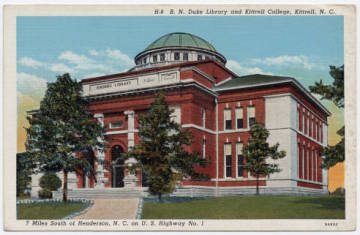
B. N. Duke Library, Kittrell College, Durwood Barbour Collection of North Carolina Postcards (P077), North Carolina Collection Photographic Archives, Wilson Library, UNC-Chapel Hill
Founded in 1886 by the African Methodist Episcopal Church as Kittrell Industrial Normal School, Kittrell College had an interesting connection with the Duke family of Durham. Washington Duke and some of his tobacco industry associates were among the school's incorporators, and in the late 1920s major buildings on the East Campus of Duke University were dismantled and reconstructed at Kittrell College.
The African Methodist Episcopal Church had a longstanding interest in education. It established Wilberforce University in Ohio prior to the Civil War. During the 1880s and 1890s, the church founded a number of schools in its Presiding Elder Districts, especially in the South.
The school in Kittrell was located in what became the Second District, which included North Carolina, Virginia, Maryland, and the District of Columbia.
The North Carolina Conference of the African Methodist Episcopal Church passed resolutions in 1885 authorizing the school and appointed a committee to select a suitable site. The committee chose property in Vance County that had once been the location of Kittrell Springs, a popular resort.
Kittrell Industrial Normal School began its first session on February 7, 1886, with a staff of three: Professor B. B. Goines, principal; Mrs. M. A. Goines, matron; and Professor John R. Hawkins, business manager.
A year later, on March 7, 1887, the North Carolina General Assembly incorporated the institution. Among its founders was the Rev. R. H.W. Leak, D.D., the "leading spirit" behind the effort to establish the school.
Some thirty other men joined Leak as members of the "body politic" listed in the legislation. They included Washington Duke, the founder of what later became the American Tobacco Company; William Thomas Blackwell, head of another tobacco manufacturing firm in Durham; and Julian Shakespeare Carr, Blackwell's business partner.
Duke's involvement likely stemmed from his strong interest in Methodism, which had a significant impact on him throughout his adult life.
Known as Kittrell College by 1906, the thriving school had an enrollment of more than 250 students in six departments: theological, college, normal (education), industrial, musical, and business. Fifteen officers and teachers provided instruction on the sixty-acre campus, which included five buildings and a brick structure then under construction at a cost of $20,000.
The Duke family's interest in Kittrell College continued well into the twentieth century. In the early 1890s, with support from Washington Duke and Julian Carr, Trinity College, a Methodist school, moved from rural Randolph County to Durham.
Impressive new buildings, including a library, were built. Then, in 1924, Duke's son, James Buchanan Duke, established the Duke Endowment, which transformed Trinity College into Duke University.
In 1927, after plans had been developed for new buildings on what became the East Campus of Duke, the library building, a dormitory, and the school's auditorium were dismantled and reassembled on the campus of Kittrell College, thus greatly enhancing the school's physical plant.
The library was renamed in honor of Benjamin Newton Duke, another of Washington Duke's sons.
Unfortunately, all three of these buildings burned around the time the college closed in 1975. Today, the campus is a federal Jobs Corps Center for disadvantaged youth.
Published in The Franklin Times on July 3, 2014.
Maury York is director of the Tar River Center for History and Culture at Louisburg College.