

Pilot Was Once Known as "Loafers Crossing"
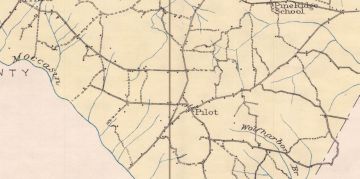
BACKWARD GLANCE. The Pilot community as seen on the map Franklin County, North Carolina, published ca. 1906 by the U.S. Geological Survey and the N.C. Geological and Economic Survey, courtesy of the State Archives of North Carolina.
Using the pseudonym "Jake Rattler," a correspondent of The Franklin Times in 1899 published an account of bustling activity in Pilot, a village in southern Franklin County. He explained why the community originally had been known as Loafers Crossing and how enterprising men were transforming it.
"When your correspondent was a mill boy," he said, "Pilot was a dense forest of pine, black jack, oak and huckleberry bush . . . situated near the source of wolf harbor creek, just where the mill path crossed the public road, with no settlement nearer than one or one and a half miles." A few years before Jake published his article, lumbermen established a saw mill at this location, "and from some lazy lad employed by the mill men, or some other cause, it was christened LOAFERS CROSSING."
Later, 100 residents of the area petitioned the government to change the name of the post office to Pilot, which was done. Thereafter, energetic locals took offense when anyone used the old name.
According to Jake, the village was rapidly improving. "Pilot can to-day proudly boast of four dry goods and grocery stores, one store with hardware department, one drug store, one wagon and buggy repair shop, one saw mill and planing mill, one grist mill, [a] cotton gin, one blacksmith shop, [and a] post office with daily mail . . . ." In addition, a tar factory supplied the "sticky stuff" by the "gourdful or barrel." Professor Cecil L. Conyers served as principal of the local school, which was open ten months a year. The writer's nearly seventy-year-old friend, L. H. Joyner, superintended the local Sunday school.
Clearly, the community had outgrown its reputation for indolence. "Mr. Editor," Jake crowed, "if you drive into Pilot and notice the level, white, sandy streets you would say 'WELL, THIS IS A PRETTY PLACE,' and then see Squire Stallings pacing around his machinery [probably the saw mill]; B. C. Pearce and the Messrs. Bunn hustling around the counters and shingle piles, you would say these are not Loafers."
The correspondent closed with an optimistic prediction: "If the present progressiveness increases and continues I know no reason why Pilot (Loafers Crossing) may not at some day be the biggest town in the State." According to Winnie Belle Brantley, who published an article about Pilot in the Special 100th Anniversary Issue of The Franklin Times (1980), some improvements did take place. In 1923, a twelve-room brick school with an auditorium was built. A frame church named in honor of L. H. Joyner was replaced in 1950 by the present Pilot Baptist Church. Pilot never grew significantly, however, and today remains unincorporated.
Published in The Franklin Times on November 26, 2014.
Maury York is director of the Tar River Center for History and Culture at Louisburg College. He wishes to thank Joe Elmore for providing source material for this article.