

Quarries in Upper Tar River Region Once Supplied Granite
Counties in the Upper Tar River region are well known for their outcroppings of granite. Many early houses in Franklin, Granville, Vance, and Warren counties retain their handsome stone chimneys, some of which reflect the craftsmanship of free black and slave masons. During the late nineteenth and early twentieth centuries, granite quarried in the region met a variety of construction needs, much of it of a local nature. Several large quarries in Vance County, however, furnished granite for projects throughout the South.
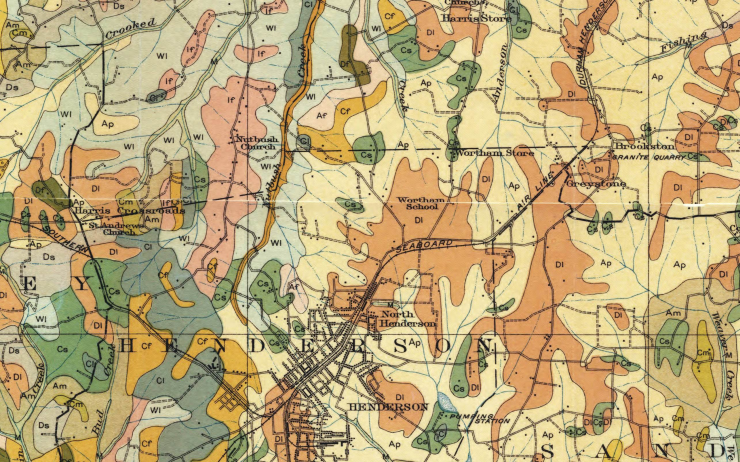
Section of Soil Map, North Carolina, Vance County Sheet (1918) showing the location of Greystone, on the Seaboard Air Line Railway. Courtesy of the North Carolina State Archives.
According to the Biennial Report of the State Geologist for 1891-92, small quarries in Granville, Franklin, and Warren counties had supplied local needs. Many large boulders in the vicinity of Oxford were split up for curbing, foundations, and trimmings for houses. A quarry north of Warren Plains, on the Raleigh and Gaston Railroad, furnished granite in 1867 and 1868 for the construction of a new jail for Warren County. The walls of this structure were then plastered, leaving only the granite window sills exposed. Franklin County in 1875 completed a new jail on East Nash Street in Louisburg. Masons built this two-story structure with granite quarried near the site.
Several quarries in Vance County yielded much larger quantities of stone. They were located near the Greystone depot of the Raleigh and Gaston Railroad (later part of the Seaboard Air Line Railway), approximately five miles northeast of Henderson. The Greystone Granite and Construction Company’s operation opened in 1889 and produced granite blocks for construction projects throughout the South until the late 1890s. In 1892, the state geologist reported that this quarry employed 115 men; these included six skilled stone dressers and twenty-five “paving-block men.” According to The Building and Ornamental Stones of North Carolina, by Thomas L. Watson and Francis B. Laney (North Carolina Geological Survey, 1906), the Seaboard Air Line Railway opened its own quarry two miles north of Greystone around 1903, but mismanaged the operation.
Quarries operated by P. Linehan and Sons at Greystone flourished over a long period of time. This company’s original quarry may have opened in the 1870s. Operations began at a second site in the early 1880s and continued well into the twentieth century. In the early 1890s, this company employed from thirty to fifty men. Machinery included three steam derricks, one drill, and two hoisting engines. The company in 1895 purchased a crushing machine and later supplied crushed rock for street and road construction projects.
In 1895, P. Linehan and Sons developed an impressive exhibit for the Cotton States and International Exposition in Atlanta, a fair that attracted nearly 800,000 visitors over a period of 100 days. An article published in The Henderson Gold Leaf on September 19, 1895, described it: “It is a stone table, the legs being blocks of granite in the rough, the corners dressed, the top a large slab with polished edges, the whole being very effective.”
Published in The Franklin Times on August 27, 2015.
Maury York is director of the Tar River Center for History and Culture at Louisburg College.